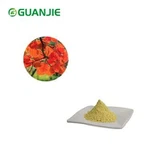
are the by-products of the hydration and degumming of soybean oil in the process of soybean oil production, which are further dehydrated and purified. Soybean phospholipid is a natural ionic surfactant with excellent performance. It has the characteristics of emulsification, softening, wetting, dispersion, penetration, humidification, non-toxic, non-irritation, non-pollution, bioactivity, antioxidant, etc. It can be widely used in cosmetics, foodstuffs, medical treatment and other industries. It can be widely used in cosmetic, food, medical health care products, textile, leather and animal feed industries. Therefore, it is of practical significance to study the physicochemical properties of soybean and its application in pharmaceuticals. Guanjie has an independent production line and has been specialized for more than 20 years.

Where R1 and R2 are saturated or unsaturated fat carboxylic acids from C14 to C15. And the difference of X constitutes different phospholipids. When X is CH2CH2N+(CH3)3, C6H6(OH)3, CH3CH2NH2, CH2CH(N+H3)COO- respectively, the phospholipids generated correspond to phosphatidylcholine (commonly known as lecithin, code PC, 27.3%), phosphatidylinositol (commonly known as myo-inositol phosphatidylcholine, code PI, 16.7%), phosphatidylethanolamine ( commonly known as ceruloplasmin, code PE, 14.3%), phosphatidylserine (code PS, 17.0%).
Pure soy lecithin is not stable in the air or under sunlight, it will oxidize and change color quickly. However, if a small amount of soybean oil exists, it can play a protective role, so that the phospholipids do not deteriorate. Soybean phospholipids do not tolerate high temperature, 80 degree began to turn brown, to 120 degree when it began to decompose. According to research, phospholipids in the early heating Mr. Conjugated dilute compounds. Then through the contact action of choline and phospholipids, the carbonyl compound is polymerized. The brown reaction of phospholipids is mainly phosphatidylcholine. Soybean phospholipids are hygroscopic and emulsify more readily in hot water or at pH 8 or higher. The lecithin of phospholipids has a fatty acid component that is nonpolar. At one end of the molecule there is a strong lipophilic fatty acid core. At the other end is a strong hydrophilic amino or phosphoric acid nucleus, thus soy lecithin is one of the few oil-soluble or oil-dispersible surfactants that are naturally consumed. In a non-homogeneous system, the phospholipid molecules are arranged in a monomolecular membrane with the fatty acid nuclei facing the lipophilic surface. While the phosphoric acid or amino acid is facing the hydrophilic surface, after such an arrangement, the surface tension at the junction of the non-uniform system can be reduced. Thus, it will soon play a wetting effect, so that the viscosity is reduced, so that the emulsification and dispersion are stabilized.

(1) Hydrolysis reaction
(2) Addition reaction In the presence of acid, nickel or peroxide and other catalysts, soybean phospholipids and hydrogen can occur addition reaction, the generation of saturated soybean phospholipids. Similarly, under certain conditions,
(3) Acetylation reaction The free amino group in the structure of brain phospholipids can react with acylating agents such as acetic anhydride and ethyl acetate to produce the corresponding acetylated products.
(4) Other reactions In the presence of aldehydes or ketones, soybean phospholipids can react with sulfuric acid or chlorosulfonic acid as sulfurizing agent. In the presence of aldehyde or ketone, soybean phospholipids can react with sulfuric acid or chlorosulfonic acid as a sulfurizing agent. In addition, soybean phospholipids can also react with Cd, P t, Hg chloride and Ca2+, Mg2+ and other metal ions to form the corresponding complex products.
are lipid compounds containing phosphate. It is commonly found in the primary and biological membranes of plant and animal cells. It has an important regulatory function on the physiological activity of biofilm and the normal metabolism of the body. Meanwhile the key component of lecithin and sphingomyelin is choline. Choline is also the precursor compound of acetylcholine, which has an important regulatory role in cellular life activities. Therefore, soy lecithin is a basic substance of life. In the pharmaceutical industry, it is known as "the protector of cells", "the scavenger of blood vessels" and the "make-up artist" of food. It is also an essential nutrient for the protection of normal human metabolism and healthy survival. It plays a very important role in the activation of human cells, the survival and maintenance of organ function, the vitality of muscles and joints, and the metabolism of fat.